ERISA Fiduciary Duties for Self-Funded Plans
Employers sponsoring self-funded plans now face the same fiduciary scrutiny as retirement plans.

Self-funded health plans put employers in the same fiduciary seat that retirement plans have occupied for decades, and most sponsors have not caught up to what that seat requires. ERISA's fiduciary rules apply to health plan dollars with the same force they apply to 401(k) dollars, yet the health side has long operated with far less scrutiny, far less litigation, and far less attention paid to whether fees are reasonable or vendors are actually being watched. That gap is closing fast, and the reasons why matter to anyone who sponsors a plan.
Congress passed ERISA in 1974 because it recognized something specific: employers who design and administer benefit plans hold nearly total control over them, and plan participants have almost none. That imbalance is why the law imposes fiduciary duties in the first place, and it applies whether the plan pays out pension checks or prescription claims. Fiduciary status doesn't come from a title or a job description. Under ERISA §3(21), fiduciary status turns on whether someone exercises discretionary authority or control over a plan or its assets, or has discretionary responsibility for plan administration. In practice, a named fiduciary is typically designated at the plan sponsor level. But vendors and third-party administrators can pick up fiduciary status too, depending on what they actually do with plan money, a point the Sixth Circuit drove home in Tiara Yachts, discussed below.
What ERISA §404 requires of plan fiduciaries
Four duties sit at the center of ERISA §404, and courts keep coming back to them.
The duty of loyalty requires fiduciaries to act solely in the interest of plan participants and beneficiaries, using plan assets only to pay benefits and cover reasonable administrative costs. The duty of prudence sets the standard of care: a fiduciary must act with the skill and diligence that a prudent person familiar with these matters would use under similar circumstances. Not the sponsor's own comfort level. Not what's convenient. The bar is what an informed, careful professional would do. The duty to follow plan documents means the plan has to be run according to its own governing terms, unless those terms conflict with ERISA itself. And the duty of reasonableness on expenses requires that plan costs and vendor compensation actually match the value of what's being delivered.
In practice, these duties appear in the daily mechanics of running a plan: administering eligibility and claims rules correctly, sending participants the disclosures they're legally owed, choosing vendors carefully and then watching them on an ongoing basis, and handling plan assets properly rather than treating them as a corporate slush fund.
ERISA §406 adds a related prohibition: certain transactions between plan assets and "parties in interest," meaning the plan sponsor or its affiliates, are barred. This connects directly to compensation review. Compensation that hasn't been disclosed can't be judged reasonable, because there's nothing to judge. And by definition, unreasonable compensation is a prohibited transaction. There's no exception for "we didn't know," because the duty is to find out.
One nuance matters here, and it cuts in the sponsor's favor: no single decision gets judged in a vacuum. Courts look at the full pattern of how a plan is managed. Picking a higher-cost vendor isn't automatically a breach if the sponsor can demonstrate the decision was made prudently and documented why it made that call. Documentation is what turns a defensible decision into a provable one.
The categories of alleged fiduciary breach driving current litigation
Three fact patterns occur repeatedly in the current wave of health plan lawsuits. A fourth is newer and is catching sponsors off guard.
Excessive administrative fees lead the list: complaints allege employers never monitored or pushed back on what TPAs, network-access vendors, and consultants were charging, and that the plan ended up paying far more than similarly sized employers pay for the same services. Imprudent prescription drug spending is close behind, with suits alleging plans overpaid for medications and never scrutinized whether PBM rebates were actually passed through to the plan rather than absorbed upstream, a structure that quietly raises what participants pay out of pocket. Failure to monitor vendors ties the two together: fiduciaries don't get to hand off a function and wash their hands of it. Delegating claims processing to a TPA leaves fiduciaries still responsible for checking whether that TPA is performing well, charging fairly, and documenting its own decisions.
The fourth category is the one sponsors saw coming the least. In December 2025, the plaintiffs' firm Schlichter Bogard filed suits targeting voluntary benefits, accident insurance, critical illness coverage, cancer policies, hospital indemnity plans, the kind of coverage employees fund themselves and that sponsors have long treated as a low-risk afterthought bolted onto open enrollment. Four class actions landed simultaneously against a major airline, a hospital system operator, a national services company, and a clinical laboratory company. of America, and they named Gallagher, Mercer, Lockton, and Willis Towers Watson as co-defendants, alleging self-dealing in how those arrangements were structured and compensated. The signal is broader than these four cases: ERISA scrutiny is no longer confined to core medical plan spending. It's reaching into benefit lines sponsors never thought to govern carefully because the money wasn't technically theirs.
How recent court decisions are reshaping the litigation landscape
Two decisions from the past few years have changed what it takes to survive a motion to dismiss, and employers need to understand both.
In Cunningham v. Cornell University, a unanimous Supreme Court addressed how prohibited transaction claims under §406(a) get pleaded. The Court held that plaintiffs don't have to plead that a §408(b) exemption fails to apply. Exemptions are affirmative defenses, and it's the defendant's job to raise and prove them, not the plaintiff's job to rule them out up front. That resolved a split among the Second, Third, Seventh, and Tenth Circuits, which had previously required plaintiffs to plead around those exemptions before a case could even proceed. The practical effect: prohibited transaction claims, which weren't the main battleground in ERISA litigation before Cunningham, are now much harder for defendants to knock out at the pleading stage. Stern v. JPMorgan Chase & Co. put the new standard to work almost immediately, where the lowered bar helped plaintiffs get past a motion to dismiss over a plan's PBM transactions.
The second decision, Tiara Yachts v. Blue Cross Blue Shield of Michigan, hit TPAs directly. The Sixth Circuit reversed a dismissal, finding that BCBSM's control over plan assets when it paid claims, combined with its discretion over its own compensation through a "Shared Savings Program," was enough on its own to make BCBSM an ERISA fiduciary, regardless of how BCBSM described its role in its own contracts. BCBSM allegedly paid out-of-state providers at full charged rates instead of the lower rates it had already negotiated locally, then enrolled self-funded customers in a program that let it keep 30% of any "savings" it recovered, a structure that built in a direct conflict of interest. TPAs have long argued they exercise no discretion and therefore carry no fiduciary exposure. Tiara Yachts says that argument doesn't hold once a TPA is shown to control plan assets or its own take. It also sits in tension with the First Circuit's 2023 ruling in a case brought in one northeastern state. Laborers' Health and Welfare Fund v. Blue Cross Blue Shield of Massachusetts, which reached a different conclusion on similar terrain, a split that may eventually pull the Supreme Court in.
Defendants haven't lost across the board. In Lewandowski and Navarro, courts dismissed claims at the motion-to-dismiss stage on standing grounds, ruling that alleged injuries were too speculative to satisfy Article III, and in Lewandowski the court also found the harm wasn't redressable. Both cases are on appeal, so the standing defense remains live but unsettled. Put together, the trend line still favors plaintiffs: prohibited transaction claims are harder to dismiss early, TPA fiduciary status is more contestable than TPAs would like, and even the standing defense that's worked so far isn't guaranteed to hold on appeal.
What the CAA 2021 and CAA 2026 demand from plan sponsors
A 2021 federal spending and healthcare law changed the disclosure landscape for health plans in a way that retirement plans had already lived with for years. Effective December 27, 2021, it amended ERISA §408(b)(2) to require brokers and consultants working with ERISA-covered group health plans to disclose their compensation whenever they reasonably expect to receive $1,000 or more, whether that compensation is direct or indirect. The disclosure has to arrive reasonably in advance of signing a contract, and it has to spell out the services being provided, the broker's fiduciary status, and every form of compensation involved. Before this law, health plans had no equivalent requirement at all; retirement plans did, health plans didn't, and that asymmetry is why health plan fee scrutiny lagged so far behind.
Receiving the disclosure isn't the finish line. Sponsors have a matching duty to actually review what they get and judge whether the arrangement and the compensation are reasonable. Skipping that step means the failure to review is itself a fiduciary breach and a prohibited transaction, not a paperwork lapse that can be waved off later.
A follow-on 2026 spending and healthcare law pushes further, extending and clarifying disclosure duties to pharmacy benefit managers, TPAs, stop-loss insurers, and most other service providers touching a group health plan. The penalty structure carries real teeth, with tiered financial penalties for non-compliance. The reforms specific to pharmacy benefit managers take effect January 1, 2029, for calendar-year plans, which sounds distant but isn't, given how long it takes to build the internal processes needed to actually use the data once it starts arriving.
None of this is transparency for its own sake. It shifts negotiating leverage toward plan sponsors, who finally get to see what they're paying for, while simultaneously raising the bar for what a prudent fiduciary is expected to do with that information. Once pricing, fee, and performance data is sitting in a sponsor's inbox, failing to act on it becomes its own evidence of imprudence. Transparency cuts both ways, and courts are increasingly comfortable saying so.
The regulatory framework, at this point, is about as clear as it's going to get. The governance structure underneath separates sponsors who meet it from sponsors who don't.
The scale of litigation entering 2026
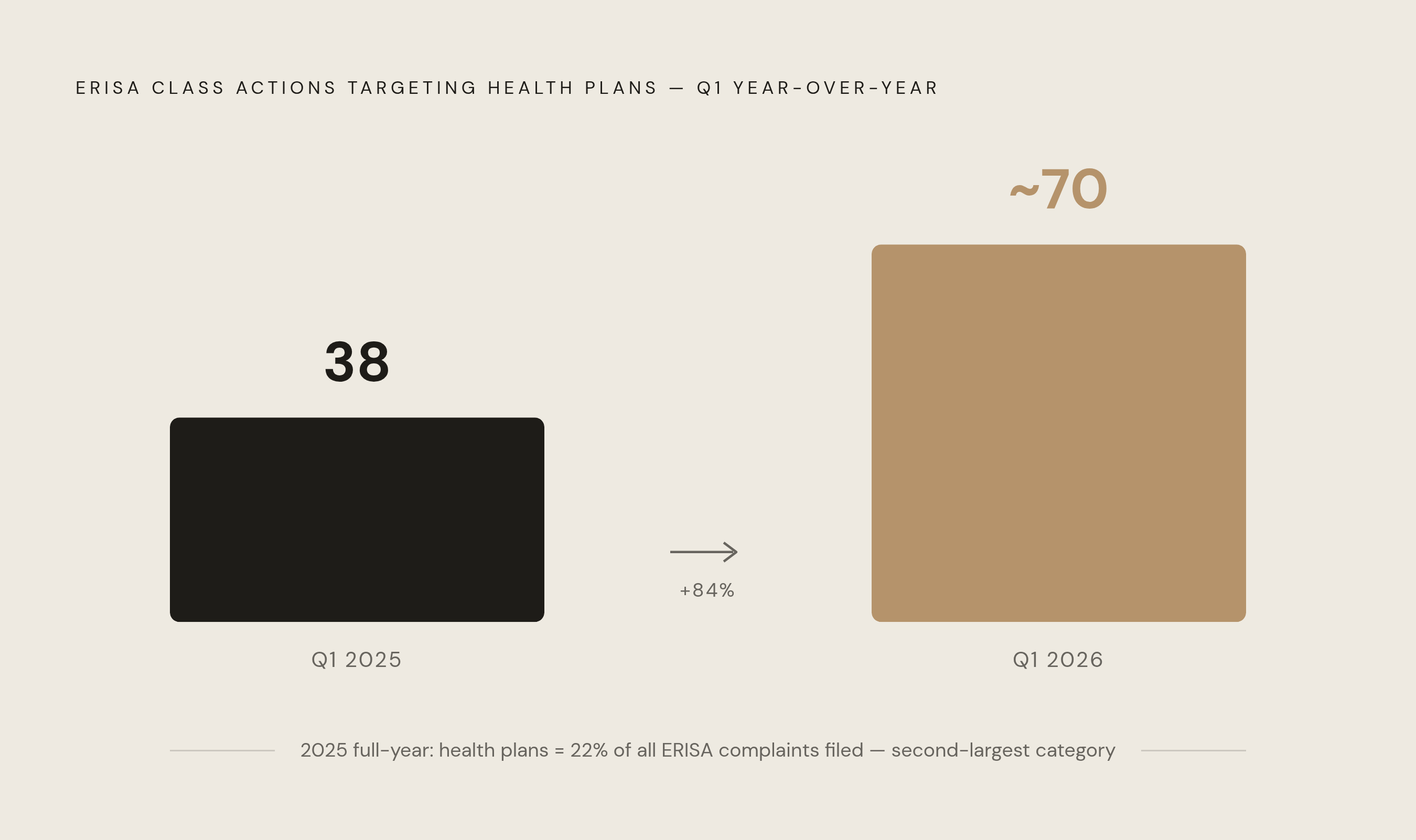
Almost 70 proposed ERISA class actions were filed in the first quarter of 2026 alone, up from 38 in the same quarter of 2025. That's not a plateau; it's an acceleration, and it lines up with a broader shift already visible in 2025 filing data: of 155 complaints filed by plaintiffs' firms alleging ERISA violations, 35 (22%) involved health plans, the second-largest category behind defined contribution retirement plans at 63%.
Plaintiffs' firms spent roughly two decades running excessive-fee litigation against the 401(k) market, largely mining out that terrain, so they turned to healthcare spending next. Plaintiffs' firms spent roughly two decades running excessive-fee litigation against the 401(k) market, a market worth a substantial sum, and largely mined that terrain out. Healthcare spending in this country. now amounts to an even larger sum, and it's far less litigated territory, with sponsors, vendors, and fee arrangements that have gone essentially unchallenged for years. The playbook plaintiffs' firms are running is the same one that worked in retirement plans: find the fee nobody negotiated, find the vendor nobody monitored, find the disclosure nobody read. Rising healthcare costs, the new transparency mandates under the CAA, and courts that are increasingly willing to scrutinize fiduciary oversight all point the same direction. None of this looks like it's slowing down heading into 2026.
Governance practices that translate fiduciary duties into operational reality
None of the above is theoretical for a sponsor sitting down to actually run a plan. The duties translate into a specific set of operational habits, and the sponsors who take litigation risk seriously build them deliberately rather than assuming good intentions are enough.
Start with formal governance infrastructure. A benefits committee, with defined membership and real decision authority, needs to meet on a regular cadence, quarterly is a reasonable baseline, and it needs written procedures that get followed consistently. Every plan-related decision, and the reasoning behind it, should be written down at the time it's made. This is not a bureaucratic nicety. Documentation is the single strongest defense against a breach allegation, because it lets a sponsor show a court what was considered and why, months or years after the fact when memories have faded.
Vendor selection deserves the same rigor retirement plan committees have applied to recordkeepers for years. Compare multiple vendors before signing anything, and build a compliance responsibility analysis into that comparison from the start. The contracts require close reading, especially the indemnification language and the fee structure, because that's where conflicts of interest hide. And once a vendor is selected, monitoring doesn't stop. Delegating administrative functions to a TPA never delegates the fiduciary duty to keep watching that TPA's performance and fees. Tiara Yachts is the reason to take this seriously: sponsors can no longer assume their TPA is a neutral administrator with no fiduciary exposure. Understanding what discretion a TPA holds over plan assets, and how it gets compensated for exercising that discretion, is now a baseline diligence question, not an advanced one.
Fee review has to be active, not passive. CAA 2021 disclosures from brokers and consultants need to actually get read and evaluated, and that evaluation, whether the fees line up with the scope and quality of services delivered, needs to be documented at the time it happens. As CAA 2026 extends these disclosure duties to PBMs and other service providers, sponsors have a runway before the 2029 effective date to build the internal process for handling that data once it starts flowing in. Waiting until 2029 to start is itself a governance failure in the making.
Claims governance rounds out the list. Claims procedures need to be written down, communicated clearly to participants, and, critically, actually followed in day-to-day administration. Courts are watching for patterns here too: Hecht v. Cigna's language about "repeated and systematic failures" in claims handling has become a reference point for what a court will treat as a fiduciary breach, and sponsors who never audit their own claims data for exactly that kind of pattern are flying blind on one of the clearest risk signals available to them.