ACA Preventive Services Mandate Status After Braidwood v. Becerra
The Supreme Court upheld the mandate but gave the Secretary unprecedented power to reshape it.

A federal health law's preventive services mandate survived the Supreme Court in June 2025, but the decision that saved it also handed the Secretary overseeing that law more control over how it operates than most plan sponsors realize. Kennedy v. Braidwood upheld Section 2713's no-cost-sharing requirement on narrow constitutional grounds, while leaving open several questions about which recommendations count, whether past ones were valid, and how much room the Secretary now has to slow or reshape the whole system. Understanding the mandate's actual status means separating what the Court settled from what it simply didn't touch.
Braidwood Management's lawsuit and its path to the Supreme Court
The case started with a Christian-owned Texas business, Braidwood Management, joined by a handful of individuals and small businesses who objected to specific corners of the preventive services mandate. Their complaint rested on two separate legal theories. First, an Appointments Clause claim: members of a federal task force. Preventive Services Task Force were never nominated by the President or confirmed by the Senate, yet they were functioning as principal officers whose recommendations carried the force of law. Second, a religious-liberty statute claim aimed specifically at the mandate's requirement to cover a particular preventive drug, taken to reduce risk of a certain infection, without cost-sharing, on the theory that this forced the plaintiffs to subsidize behavior they found morally objectionable.
A federal district judge, the federal district judge sided with the plaintiffs on both counts. He struck down the USPSTF mandate going back to March 23, 2010, ruled the PrEP coverage requirement violated RFRA, and issued a nationwide injunction vacating the government's enforcement of the USPSTF mandate.
The Fifth Circuit agreed that Task Force members hadn't been constitutionally appointed, but it pulled back the remedy considerably. Rather than a universal injunction, relief applied only to the named plaintiffs. The appeals court also found the two federal bodies' underlying authority constitutionally sound, though it sent back questions about whether those two bodies had followed proper administrative procedure under governing federal law. From there, the case moved toward the Supreme Court on an unusual bipartisan footing. The outgoing administration's executive-branch legal office petitioned for certiorari in September 2024, and the Court granted review on January 10, 2025, just days before the change in administration. Notably, the Biden and Trump administrations advanced the identical argument once the case reached the Court: that USPSTF members were inferior officers, not principal ones, and their appointment scheme was lawful all along.
What the Supreme Court's 6–3 ruling in Kennedy v. Braidwood held
Decided June 27, 2025, after argument that April, Kennedy v. Braidwood Management came down 6-3. One member of the majority wrote for a coalition that included the Court's presiding member along with four other members, an unusual ideological mix for a case with these stakes. Justice Thomas dissented, joined by two other justices.
The majority's holding is narrow but firm: USPSTF members are inferior officers under the founding charter, not principal officers, so their appointment by the HHS Secretary satisfies the Appointments Clause without any need for Senate confirmation. The mandate stands.
Kavanaugh's reasoning turned on two features working together. The Secretary can remove any Task Force member at will, with no cause required, and the Secretary has statutory authority to review Task Force recommendations and block them before they take effect and bind insurers. Either power alone might not settle the question, but combined, they mean the Task Force is directed and supervised closely enough by the Secretary, who in turn answers to the President, to preserve the accountability structure Article II demands. That's the whole doctrinal move: control substitutes for confirmation.
The structural power the ruling quietly confirmed: the Secretary's control over USPSTF
The logic that saved the mandate cuts in a direction plan sponsors should sit with for a moment. To find USPSTF members were inferior officers, the Court had to find the Secretary genuinely controls them, and that finding is now binding law, not a policy preference of whoever happens to hold the office.
What does that control actually consist of? The Secretary can fire any Task Force member without cause, replace them with people whose views align with the administration's priorities, delay a recommendation for the full year before it would otherwise bind insurers, and block it outright before it takes effect. None of this is new authority invented by the Court. It's authority the statute already granted, but Braidwood turned it from a background legal fact into the Court's own stated justification for upholding the mandate.
Some legal observers have called this a pyrrhic victory for supporters of the preventive care requirement. The mandate survived, yes, but the price of survival was a Supreme Court opinion confirming, in plain terms, that the Secretary can steer the body that decides which cancer screenings and drug therapies must be covered for free. It's already playing out. It's already playing out.
Secretary Kennedy's use of those powers since the ruling
Before the ruling even landed, the Task Force had gone mostly quiet, effectively dormant for more than a year. Secretary Kennedy canceled its scheduled July 2025 meeting. The November 2025 meeting was called off due to a government shutdown. A sustained stretch with functionally no meetings is a significant disruption to its output.
Membership has thinned out too. Several of the Task Force's 16 volunteer seats have seen terms expire, and as of the most recent reporting, those seats sit unfilled. New members are chosen by the HHS Secretary, so every vacancy is an opportunity to reshape the panel's composition.
Then came the personnel move that made the pattern impossible to ignore: Kennedy dismissed the Task Force's two vice chairs, John Wong, MD, and Esa Davis, MD, MPH. The termination letters framed the removals as unrelated to performance and noted both physicians remain eligible to reapply for their seats, language that reads less like a routine housecleaning and more like a reset. Legal observers have pointed out this sequence, cancel meetings, let seats lapse, remove leadership, tracks closely with something HHS already did to a different advisory body.
The ACIP parallel: what reconstitution of the vaccine committee means for coverage
A federal immunization advisory body sits alongside the task force and another federal health resources agency as one of three bodies whose recommendations trigger the underlying law's no-cost-sharing requirement, in that advisory body's case covering vaccines. Kennedy had already exercised his removal authority over ACIP before Braidwood was decided, dismissing the sitting members and replacing them with advisors more closely aligned with his own views on vaccine policy. Braidwood didn't create that precedent. It confirmed, under the Court's own reasoning, that removal and supervisory authority over USPSTF is constitutionally grounded in the same logic.
The consequences for ACIP are not abstract. When the reconstituted committee drops a vaccine recommendation, insurers are no longer obligated to cover it without cost-sharing. A recommendation disappearing from ACIP's list translates directly and immediately into a coverage obligation disappearing for insurers.
The insurance industry has responded by stepping in ahead of the legal requirement. America's Health Insurance Plans announced that member insurers would keep covering, without cost-sharing, vaccines that had previously carried ACIP's recommendation. That's a voluntary industry commitment sitting on top of a legal mandate that has already narrowed. It buys time, but it's a stopgap rather than a permanent substitute for the underlying recommendation structure, and it says nothing about what happens to the task force's recommended services if a comparable reconstitution plays out there.
Three legal questions the Supreme Court's ruling left open
The Braidwood opinion is precise about what it decided, and reporting on it accurately means being just as precise about what it didn't.
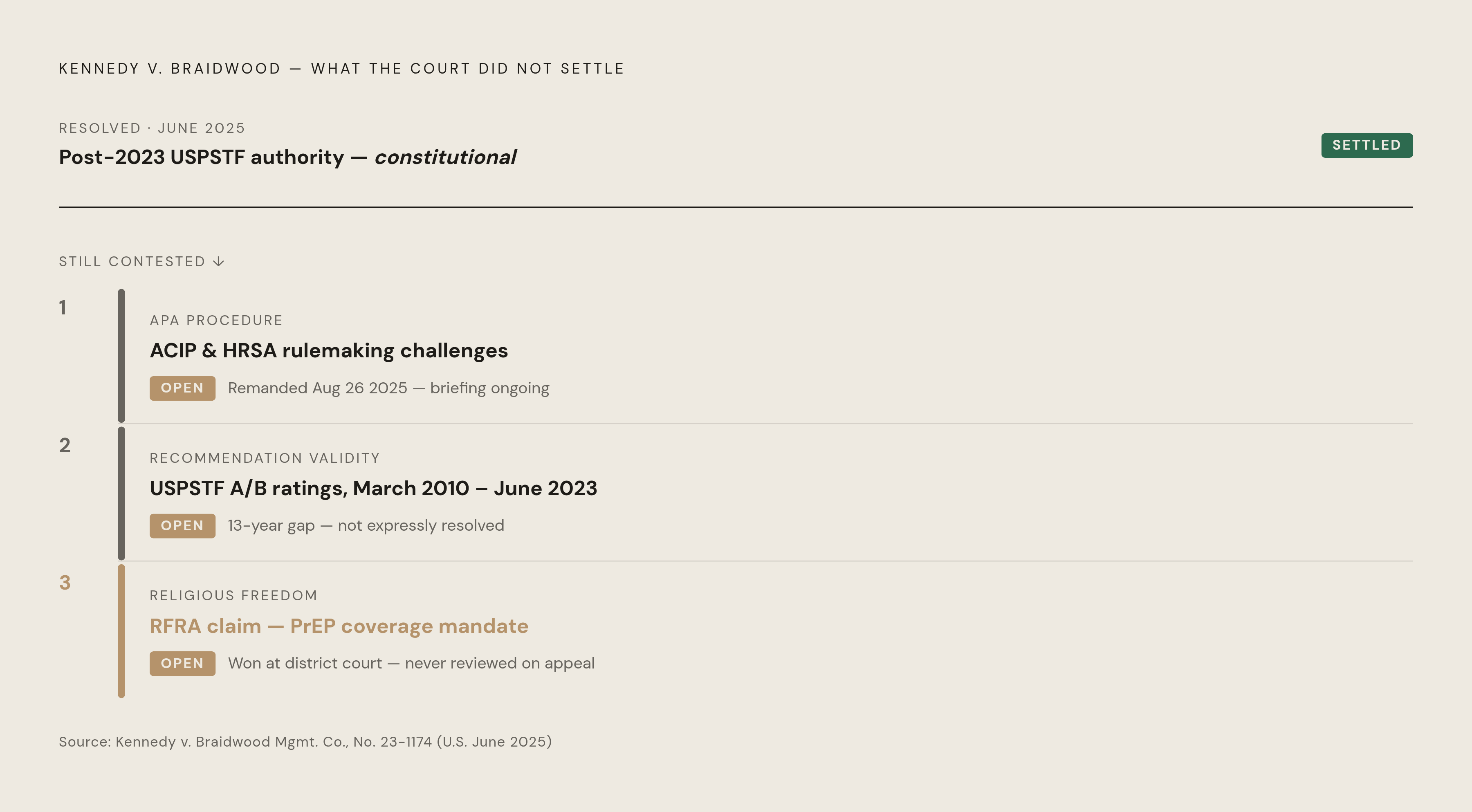
First, the APA claims involving HRSA and ACIP never reached the Supreme Court. The Court's opinion addresses the Appointments Clause challenge to USPSTF and stops there. On August 26, 2025, the appeals court sent the case back to the district court to resolve whether the Secretary's ratification of the two bodies' recommendations complied with applicable federal administrative law requirements. Briefing has resumed at the district court, and the outcome is genuinely unresolved.
Second, there's a timing gap the ruling doesn't paper over. Before June 2023, task force members were appointed solely by the director of a federal research agency, not the Secretary personally. Secretary Becerra reappointed the full membership in June 2023, and the Court's holding clearly validates appointments from that point forward. What it does not expressly resolve is the status of recommendations finalized between March 2010 and June 2023, a thirteen-year span covering a large share of the more than 50 current A/B recommendations. Depending on how the remand proceedings develop, that gap could end up mattering for a substantial slice of preventive services currently treated as settled law.
Third, the RFRA claim over PrEP coverage never came before the Supreme Court either. The original plaintiffs won that claim at the district court, and that victory has never been reviewed on appeal, so it remains a live, unresolved question rather than a closed one. Given that the Court has previously required religious-objection exceptions in contraceptive-coverage cases, conservative employers and advocacy groups have an obvious template to work from if they choose to press the same argument toward PrEP in future litigation or rulemaking.
What remains uncertain for plan sponsors and covered individuals
Some things are genuinely locked in. Non-grandfathered group health plans and insurers must keep covering USPSTF A/B-rated services without cost-sharing, no deductibles, no copays, nothing out of pocket. The Appointments Clause challenge failed, and with it, the argument that the whole USPSTF mandate is unconstitutional. Just as firmly settled, if less comfortably so, is that the HHS Secretary now holds court-confirmed authority to direct, supervise, and remove Task Force members at will.
What's already shifted in practice matters just as much as what the Court held on paper. ACIP's reconstitution has already narrowed the set of vaccines insurers must cover without cost-sharing, and further changes remain possible as the new panel continues its work. USPSTF's output, meanwhile, has effectively stalled: canceled meetings, seats sitting unfilled, and two leadership firings mean the pipeline of new A/B recommendations has slowed to a trickle or stopped. Services with recommendations already on the books stay mandated. What's missing is the ordinary churn of updates and additions that used to keep the list current.
Three fronts remain genuinely open and worth watching closely. The APA challenges to ACIP and HRSA procedures are back in front of the district court. The validity of USPSTF recommendations issued before June 2023 is still an unresolved legal question rather than a settled one. And the RFRA-based fight over PrEP coverage remains available for another round of litigation. None of these questions has an answer yet, and anyone advising plan sponsors or covered individuals should treat "settled" and "still contested" as two very different categories, not interchangeable ways of describing where things currently stand.
Sources
- Supreme Court Upholds the ACA Preventive Services Mandate - Miller Johnson
- Explaining Litigation Challenging the ACA’s Preventive Services Requirements: Braidwood Management Inc. v. Becerra | KFF
- Kennedy v. Braidwood Management, Inc. - Wikipedia
- kff.org
- kff.org
- Kennedy v. Braidwood Management, Inc. (24-316)
- healthaffairs.org
- Preserving the ACA's Preventive Services Protections in the Wake of Braidwood v. Becerra: A Checklist of State Options - State Health and Value Strategies ~ Driving Innovation Across States